
Flat Roof Repair in the USA
Flat roof assemblies on homes and additions require attention to small surface changes because water has few paths to escape. Wynnewood Roof Repair technicians trace how temperature swings, foot traffic and debris affect single-ply sheets or built-up layers over time. They measure remaining membrane thickness and note where ponding occurs near drains or scuppers.
Our crews also review how original roof edges meet walls and parapets. Older row-house flat sections often use copper or lead flashing that fatigues at corners. Wynnewood Roof Repair records these transitions and checks for open laps or separated base flashings before any work plan is prepared. Twin home owners note that careful flashing work by Wynnewood Roof Repair resolves flat roof repair without disturbing original features.
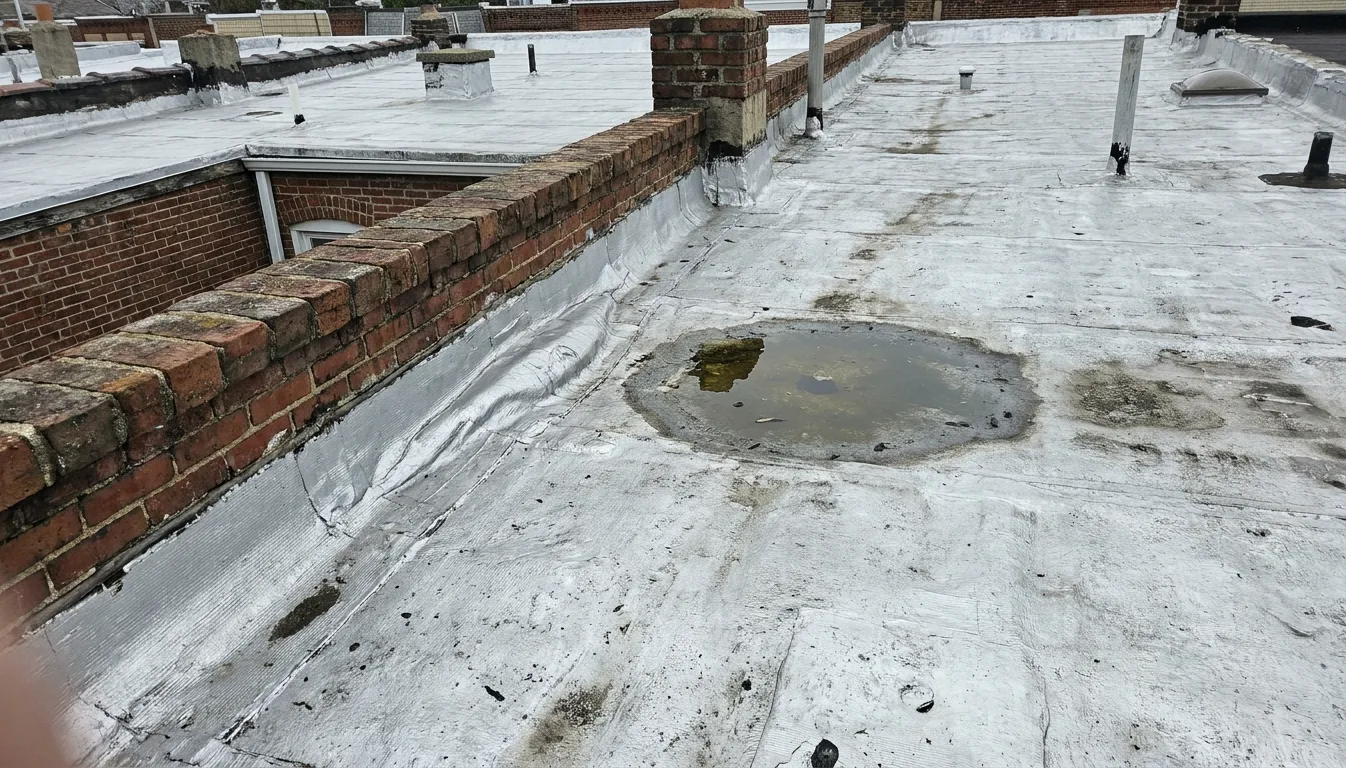
Visible Indicators of Flat Roof Distress
- Blisters or bubbles lifting membrane from insulation below
- Standing water remaining hours after rainfall ends
- Stains or efflorescence along interior ceiling edges
- Degraded seam tape curling at lap joints
- Rust streaks from fasteners or metal edges
Typical Sources of Flat Roof Water Entry
Ponding develops when roof slope falls below one-quarter inch per foot or when drains clog with leaves and granules. The constant moisture softens insulation boards and allows water to migrate under the membrane at any small opening. Wynnewood Roof Repair crews map these low areas and note whether scuppers or interior leaders can be cleared from above.
Seam failure occurs when adhesive ages or when thermal movement pulls sheets apart. On older modified-bitumen roofs the torch-applied laps can separate at the toe. Technicians probe each lap with a flat tool to test adhesion before deciding whether a patch or full overlay is appropriate.
Flashing at curbs and penetrations cracks when the metal or membrane expands differently. Skylight bases and HVAC curbs are common points where original mastic dries and shrinks. Wynnewood Roof Repair replaces these components with compatible materials rather than relying on surface caulk alone.
Inspection Steps Performed by Technicians
Technicians begin at the roof edge and walk parallel lines while noting surface texture changes. They record membrane color fading, granule loss and any areas where ballast has shifted. Core samples are taken only when insulation moisture is suspected, then patched immediately.
Drainage testing follows. Hoses are used to observe how quickly water reaches leaders and whether overflow scuppers function. Interior ceilings are checked with moisture meters from below to confirm the leak path before any surface repair begins.
Fastener pull-out tests are performed on mechanically attached systems. Loose plates indicate insulation movement beneath the sheet. Wynnewood Roof Repair logs these measurements to determine whether reattachment or a new mechanically fastened layer is needed.
Repair and Replacement Choices Available
Small isolated breaches receive target patches that extend at least six inches beyond the damaged zone. The surrounding membrane is cleaned and primed so the new material bonds fully. For multiple breaches within a small area, a recovery board and new membrane overlay may be installed over the existing surface.
When insulation is saturated the affected area is cut out and replaced with matching thickness material. The new insulation is then covered with a membrane that matches the existing system type. Wynnewood Roof Repair ensures the patch slope matches surrounding drainage patterns.
Complete replacement becomes necessary when more than thirty percent of the membrane shows widespread alligatoring or when the deck itself has deteriorated. In those cases the old assembly is removed down to the structural deck and a new tapered insulation system is installed to improve drainage.
Materials Selected for Flat Roof Systems
EPDM sheets remain popular for their flexibility in cold weather. Wynnewood Roof Repair uses 60-mil reinforced membrane at seams and 90-mil where foot traffic is expected. All seams are sealed with compatible tape and primer rather than liquid adhesive alone.
TPO membranes offer heat-welded seams that create a monolithic surface. Technicians select white or light-gray sheets to reduce heat gain on the structure below. Edge details use pre-formed corners and custom-fabricated boots at pipes to maintain consistent weld strength.
Modified-bitumen cap sheets provide a durable surface for roofs that receive occasional maintenance traffic. Torch or cold-applied base sheets are chosen based on existing deck conditions. Granule surfacing is matched to the original color so the repair blends visually with remaining sections.
Flat Roof Repair questions
How does Wynnewood Roof Repair locate the source of a flat roof leak?
Technicians walk the entire surface and use moisture meters on both the membrane and interior ceilings. They trace staining patterns back to penetrations, seams or low spots. Core samples confirm whether insulation is wet, guiding the exact repair limits.
What preparation should a homeowner complete before a technician arrives?
Move attic items away from suspected leak areas and place towels or buckets under active drips. Note the date and time of each interior stain so the pattern can be compared with roof conditions. Avoid walking on the roof surface.
Can a flat roof receive a new membrane without removing the old layers?
A recovery board can be installed over an existing sound assembly when weight limits allow. Wynnewood Roof Repair checks deck deflection and existing moisture first. If saturated insulation is present, removal of the wet sections is required before the new system is applied.
Which drainage components receive the most attention during repair?
Interior drains, scuppers and overflow outlets are cleared and their flanges resealed. Technicians verify that crickets direct water toward these points and that strainers remain securely attached so debris does not reaccumulate quickly.
Flat Roof Repair Assessment
Contact Wynnewood Roof Repair to schedule an inspection of your flat roof system and receive a written scope of work for needed repairs.