
Slate Roof Repair in the USA
Wynnewood Roof Repair addresses slate roofs on older homes by first examining how individual tiles sit on their nails and whether copper flashings have separated at valleys or chimneys. Our technicians note the thickness and edge condition of each slate because thin or delaminated pieces allow water to reach the felt beneath and eventually the plaster ceilings inside. They also check for nail rust that lifts slates out of alignment on steep pitches common to row homes.
Slate roofs in the USA often suffer from incompatible replacement pieces that expand differently in freeze-thaw cycles. We measure the remaining slate overlap and record any previous cement patches that have cracked away. This information guides whether isolated tiles can be slid into place or whether larger sections require removal down to sound underlayment. Plaster ceiling stains often trace back to roof issues prompting Wynnewood Roof Repair to assess slate roof repair in the USA.
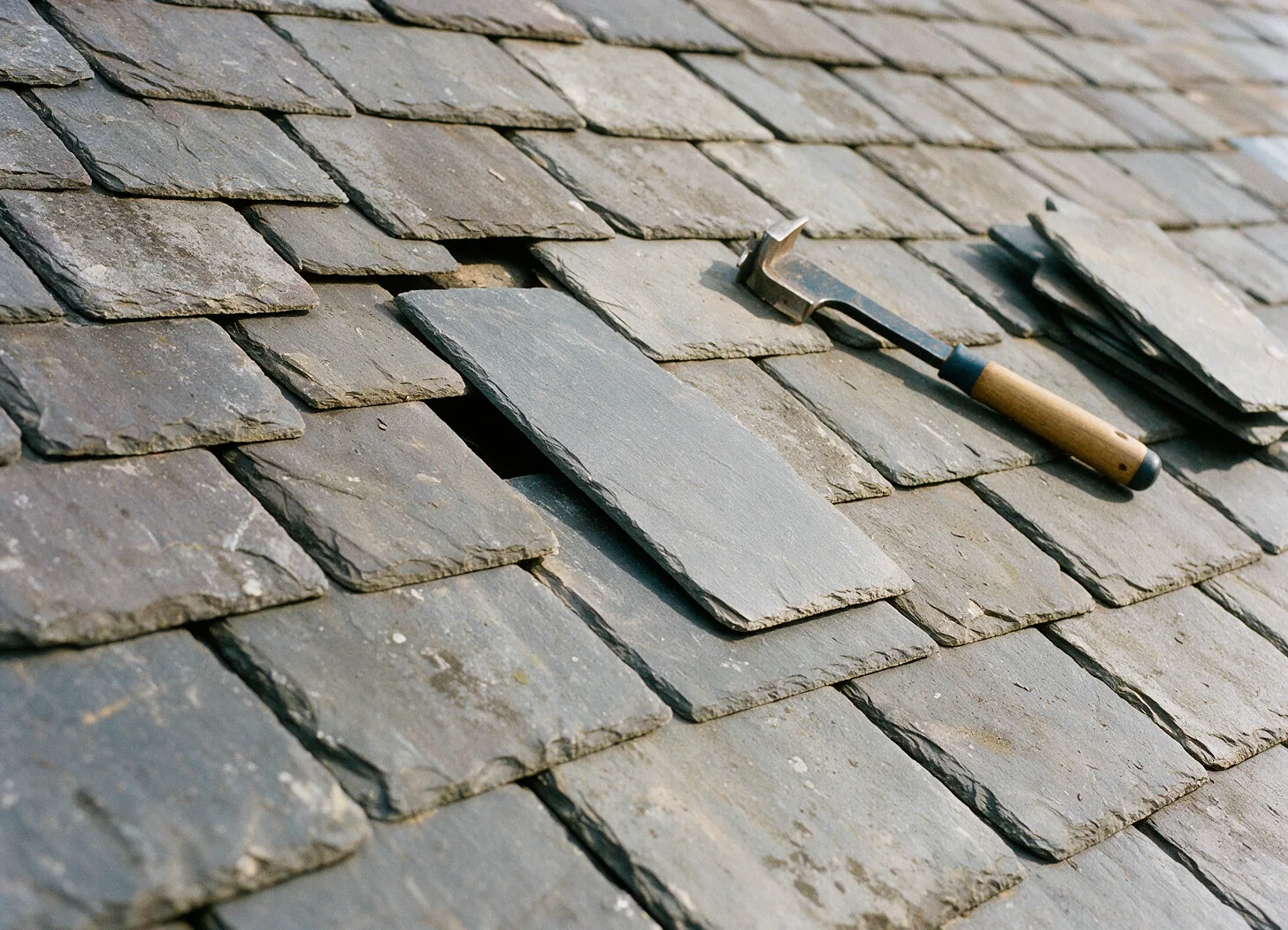
Early Indicators on Slate Roofs
- Dark streaks running down from nail holes on individual slates
- Slate pieces lying in the yard after high winds
- Water marks appearing on plaster near chimney walls
- Daylight visible through gaps when viewed from the attic
- Copper flashing edges lifted away from the slate surface
Common Causes of Slate Failure
Slate roofs lose integrity when the original copper nails corrode and allow tiles to slide downward. On twin homes this movement often starts at the shared wall where temperature differences accelerate rust. Once a single course shifts, water follows the exposed nail holes straight to the sheathing.
Another frequent cause is the use of modern asphalt cement on older slate. The cement hardens, cracks, and then traps moisture against the slate back. Over time the trapped water freezes, spalls the slate edges, and widens the gap for the next storm.
Inspection Points Our Technicians Measure
Technicians begin at the ridge and work downward, recording slate thickness at several courses and noting whether the original lap is still two inches or more. They test copper flashing with a magnet to confirm it is not steel that has been painted to look like copper. Any ridge where slates no longer touch the course above receives special attention because that is where wind-driven rain first enters.
In the attic they look for dark staining on rafters directly below valleys and measure the distance between staining and the nearest roof penetration. This tells them whether the leak is traveling along the felt or has already reached the plaster lath.
Repair and Replacement Options
When only scattered slates are damaged we slide new pieces of matching thickness into place using copper bibs that hook over the course above. This method avoids disturbing sound tiles and keeps the roof watertight without full tear-off. For areas where multiple courses have failed we remove down to the felt, install new copper step flashing, and reinstall original-style slate with stainless steel hooks.
Where the entire slope shows widespread nail rust we recommend a complete re-roof using salvaged or new slate of the same color and texture. Copper valleys are replaced at the same time so dissimilar metals do not create future corrosion problems.
First Actions Before Technicians Arrive
Homeowners should enter the attic with a flashlight after the next rain and mark every wet rafter with chalk so the leak path is clear. They should also photograph any fallen slate from the ground without climbing the roof, noting the general area where the pieces originated.
Avoid placing buckets directly on plaster ceilings. Instead, move furniture and cover floors because water can travel along lath and drip several feet from the actual roof entry point.
Slate Roof Repair questions
How long does a typical slate repair last?
Isolated slate replacements using copper bibs often remain serviceable for twenty years or more when the surrounding tiles and underlayment are still sound. Larger section repairs tied into existing copper last as long as the original roof because the new work matches the material and fastening methods.
Can damaged slate be reused after repair?
Whole slates with only minor edge chips can be reinstalled in less visible locations. Broken pieces are discarded because a second nail hole weakens the tile and increases the chance of future splitting along the grain.
What happens if flashing is not replaced during repair?
Old copper that has thinned at the folds will continue to leak even after new slate is installed. Water travels under the new tiles and reaches the same interior plaster that was already stained, requiring the work to be redone.
Is it safe to walk on a slate roof during inspection?
Our technicians use roof ladders and walk boards to distribute weight across multiple courses. Direct foot traffic on slate can crack the stone or dislodge nails, so all movement stays on the ladder or boards until the condition of each tile is assessed.
Slate Roof Repair Across the USA
Contact Wynnewood Roof Repair to schedule an inspection of your slate roof and receive a written scope of needed work.